The Ruins of Babylon
The capital of Nebuchadnezzar and the centre of the ancient world, where you walk restored palace ruins and stand before the famous Lion of Babylon.
On the banks of the Euphrates, some eighty-five kilometres south of Baghdad, Babylon rises as the greatest capital of the ancient world and one of the deepest imprints on human memory. The city reached the summit of its glory under King Nebuchadnezzar II in the sixth century BCE, when it became the heart of the Neo-Babylonian Empire and a centre of science, astronomy, law and architecture. Here the earliest written codes were refined, the movements of stars and planets were charted, and foundations were laid in mathematics and the calendar whose traces still shape our civilisation today.
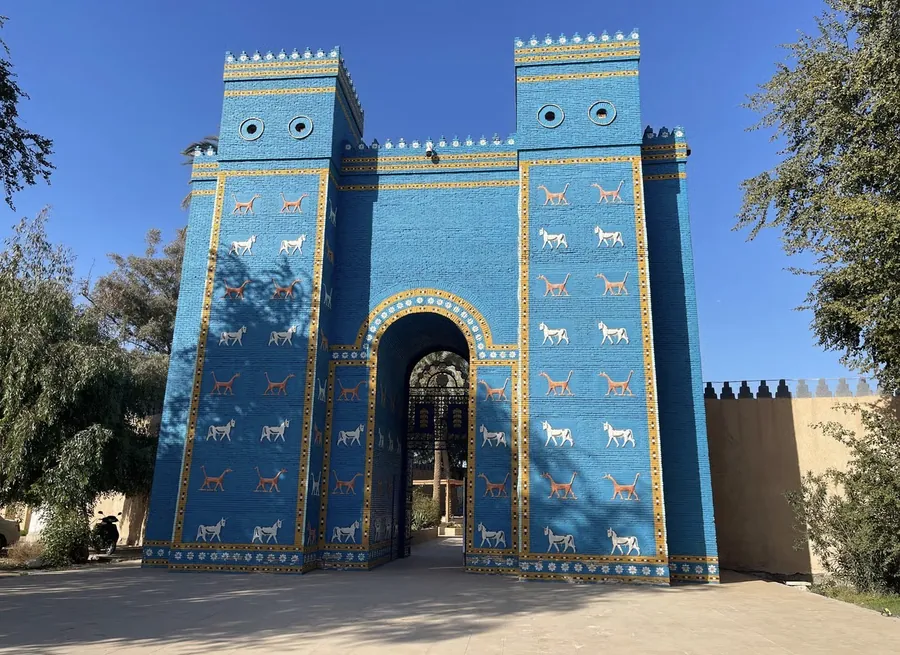
Your visit is led by the Ishtar Gate, a masterpiece sheathed in glazed brick the colour of lapis lazuli, crowned with reliefs of the dragon of the god Marduk and the bulls of the god Adad — a harmony of colour and symbol the ancient world never equalled. From the gate extends the Processional Way, trodden by kings and priests in seasons of festival, so that you walk the very path on which history was made. At the heart of the site stands the Lion of Babylon, carved from basalt, an enduring emblem of power and majesty that has watched over the city for thousands of years.
No telling of Babylon is complete without the Hanging Gardens, one of the Seven Wonders of the world, which tradition attributes to Nebuchadnezzar as a gift to his wife Amytis, to remind her of the green mountains of her homeland — terraced gardens said to have been watered by an ingenious engineering system centuries ahead of its time. Beside them, the ziggurat of Etemenanki once rose toward the heavens, inspiring the great tower legends of human heritage and making Babylon an icon of architectural ambition without limit.
Babylon's story reaches back centuries before Nebuchadnezzar, to the age of King Hammurabi, who immortalised his name with the earliest complete code of law — justice carved in diorite stone before the nations knew it. Conquerors and sages passed through her gates: Cyrus the Persian entered, and Alexander the Great died here while dreaming of making the city his capital. Ancient historians described her soaring walls and countless towers, until in human memory Babylon became the very model of a universal city. In our journey an unhurried, three-language narration and generous time at her finest vantage points turn every stone into a doorway to a story.
Today, inscribed on the UNESCO World Heritage List, Babylon offers far more than a walk among ruins; it is a moment of standing in the place where the very idea of the city, the empire and civilisation was born. With our private accompaniment and unhurried narration, silent stones become living narrative, and Babylon is restored before your eyes as it was when it ruled the world.